
Uncategorized
Coping with Loneliness and Building Social Connections
The Loneliness Epidemic in America: Causes, Health Impact, and Strategies for Connection Loneliness is a deeply human experience, but in...

Uncategorized


Setting and maintaining healthy boundaries is fundamental to well-being, yet it remains a challenge for many Americans navigating a culture that prizes both individualism and connection. In a society where work, family, and social obligations often blur together, understanding and upholding personal limits is not just an act of self-care but a necessity for mental, emotional, and even physical health.
This comprehensive guide explores what boundaries are, why they matter, the different types of boundaries, and practical strategies for establishing and maintaining them in various areas of life.
According to UC Davis Health, boundaries are the limits we set for ourselves to define what we are comfortable with and how we wish to be treated by others. They encompass physical, emotional, time, material, and digital aspects of our lives.
Setting boundaries is about clarifying where our responsibilities end and someone else’s begin, which is vital for maintaining self-respect and healthy relationships.
In the American context, boundaries are often seen as a reflection of self-advocacy and autonomy. According to Mayo Clinic Health System, they help us protect our time, energy, and emotional well-being, ensuring that we are not overwhelmed or exploited by the demands of others.
Healthy boundaries foster mutual respect, prevent burnout, and are linked to lower rates of anxiety and depression. The Caldwell Memorial emphasizes that boundaries are an act of self-care, not selfishness.
Boundaries can be categorized in several ways, each serving a unique function in our lives. According to Personal Development School, the main types include:
Each type of boundary is crucial for different scenarios—whether it is declining an invitation, asking a colleague to respect your off-hours, or limiting social media use.
America’s individualistic culture encourages people to assert their needs and desires, often making boundary setting a celebrated skill. However, according to the American Counseling Association, this can also lead to misunderstandings, especially among those from collectivist backgrounds where group harmony and familial obligations are prioritized over personal needs.
For immigrants and those from non-Western cultures, the American approach to boundaries may feel alien or even selfish, causing guilt or internal conflict. On Your Mind Counselling notes that cultural sensitivity is essential when discussing boundaries with diverse populations.
Despite these cultural nuances, the dominant narrative in American society and therapy emphasizes that setting boundaries is not only acceptable but essential for nurturing healthy relationships and self-respect.
Setting boundaries can be uncomfortable, especially if you are not used to advocating for yourself or fear disappointing others. According to Greater Good Magazine from UC Berkeley, many Americans struggle with saying “no,” worrying it might be perceived as rude or selfish.
In families or workplaces where boundaries are not respected, asserting your needs may be met with resistance or guilt. Public Square Magazine explores how boundary-setting can be particularly challenging in high-demand environments.
Moreover, the rise of remote work and digital connectivity has made it harder to maintain clear boundaries between personal and professional life, leading to increased stress and burnout. According to Baylor University, the COVID-19 pandemic forced many to renegotiate boundaries around social interactions, work hours, and even physical space within their homes.
Establishing and maintaining healthy boundaries offers numerous benefits, according to Positive Psychology:
Life Insight adds that boundaries also improve decision-making, increase resilience, and enhance overall life satisfaction.
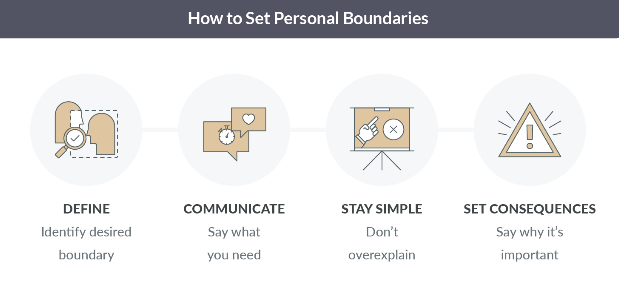
Setting boundaries is a skill that can be learned and refined. According to Women Rise Chicago, here are practical steps to establish and maintain them:
Reflect on what makes you feel safe, respected, and fulfilled. Ask yourself questions such as: What drains my energy? What do I need to feel happy and secure? What behaviors am I no longer willing to tolerate? According to See Beyond, self-awareness is the foundation of effective boundary-setting.
Once you know your boundaries, communicate them directly and respectfully. Use clear language and avoid ambiguity. For example: “I am not available to answer work emails after 6 p.m.” or “I need some time alone to recharge.” Harvard Business Review offers excellent guidance on assertive communication.
If boundary setting is new to you, begin with less challenging situations. Gradually build confidence by asserting your needs in increasingly significant areas of your life. Stanford University recommends practicing with low-stakes scenarios first.
Consistency is key to maintaining boundaries. If someone violates your boundary, remind them of your limits and enforce consequences if necessary. This reinforces your commitment to your own well-being. Forbes notes that consistency builds trust and respect over time.
Just as you expect your boundaries to be honored, make an effort to respect the boundaries of others. This mutual respect is the foundation of healthy relationships. According to Psychology Today, reciprocity is essential for sustainable relationships.
Boundaries are not static. As your needs and circumstances change, revisit and adjust your boundaries accordingly. Regular self-reflection ensures your boundaries continue to serve your well-being. Therapy with Olivia suggests quarterly boundary check-ins.
It is normal to encounter resistance—both from yourself and others—when setting boundaries. Here is how to navigate common challenges according to University of Iowa:
Reddit’s DecidingToBeBetter community offers real-world examples of people successfully navigating boundary challenges.
The American workplace often blurs the line between professional and personal life. According to Georgetown University, setting boundaries at work might include:
Family dynamics can make boundary setting especially challenging. According to Thriving Center of Psychology, strategies include:
With technology permeating every aspect of life, digital boundaries are increasingly important. Healing with Wisdom recommends:
Many thought leaders emphasize the transformative power of boundaries. As compiled by Psych Central and Parade:
“Boundaries are a part of self-care. They are healthy, normal and necessary.” – Doreen Virtue
“Healthy boundaries are not walls. They are gates and fences that allow you to enjoy the beauty of your own garden.” – Lydia Hall
“Setting and implementing boundaries is one of the most empowering things you can do for yourself.” – Laurie Buchanan, PhD
“No is a complete sentence.” – Anne Lamott
“The difference between successful people and really successful people is that really successful people say no to almost everything.” – Warren Buffett
These quotes remind us that boundaries are not about shutting others out, but about creating space for self-respect, growth, and meaningful connection.
If you find boundary setting particularly difficult, seeking support from a therapist or counselor can be invaluable. According to Psychiatry Online, professionals can help you explore underlying beliefs, develop assertiveness skills, and practice new behaviors in a safe environment.
Therapists can also help address trauma histories that may make boundary-setting feel unsafe, as well as cultural and family-of-origin issues that complicate boundary development.
For a quick assessment of your mental health, take this free 5-question mental health check.
If you are looking for a mental health provider, please schedule an appointment with our team.
In a fast-paced, achievement-oriented society like America’s, the ability to set and maintain healthy boundaries is more crucial than ever. Boundaries empower us to prioritize our needs, protect our well-being, and cultivate relationships that are rooted in respect and authenticity.
While the process may be uncomfortable at first, the long-term benefits—improved mental health, greater self-respect, and more fulfilling relationships—are well worth the effort.
Remember, boundaries are not about building walls but about defining the space where you can thrive. By embracing the practice of setting and maintaining healthy boundaries, Americans can foster a culture of self-care, resilience, and genuine connection—one respectful “no” at a time.
Please note: This blog is for informational purposes only and is not a substitute for professional medical advice, diagnosis, or treatment. Always seek the advice of your mental health provider with any questions you may have regarding a medical condition.
This comprehensive guide was published on May 18, 2026. Sources include UC Davis Health, Mayo Clinic Health System, UC Berkeley Greater Good, Harvard Business Review, Stanford University, Forbes, Psychology Today, Georgetown University, and the American Counseling Association.
JOURNAL
Uncategorized
The Loneliness Epidemic in America: Causes, Health Impact, and Strategies for Connection Loneliness is a deeply human experience, but in...
Uncategorized
Veterans’ Mental Health: Understanding Unique Challenges and Finding Support America’s veterans are a diverse and resilient group, yet their service...

Uncategorized
Therapist Tips for Parents Supporting Children’s Mental Health: A Complete Guide Children’s mental health is a growing concern in the...
Whether you're seeking support for yourself, your child, your relationship, or your family, we're here to help. Complete the form below, and we'll contact you to discuss your needs and schedule your consultation.
Direct Inquiry
info@ourmhm.org